Genius
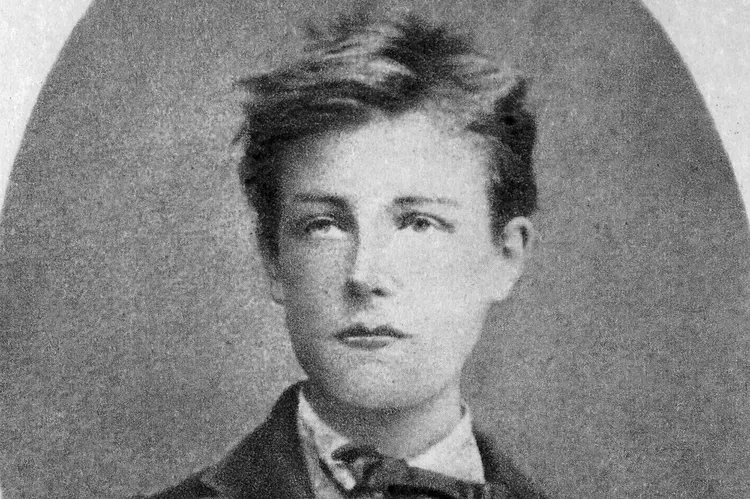
I learned about Arthur Rimbaud when I was fifteen and became fascinated by him: a young French poet who became one of the precursors of the Symbolist movement in the late 1800s.
I thought his poetry was beautiful and strange in a way nothing compared to it at the time. Rimbaud used language to evoke the mystique of the world rather than describe it, creating unexpected relationships between things: sounds, colors, sensations, symbols and emotions.
His writing was spiritual rather than literal. In many ways, reading him felt like a voyage into an altered state of perception.
But what really fascinated me wasn’t his poetry, it was him.
Rimbaud wrote the bulk of his work between fifteen and twenty. And then, at twenty-one, he stopped. He left poetry behind and went on to become a trader, traveling across continents.
I’ve always wondered how someone so gifted could walk away from what made him extraordinary, so young. He never gave an explanation, but there’s a line attributed to him that could give a hint:
“Idle youth, enslaved to everything; by being too sensitive I have wasted my life”.
It’s like something in him burned too hot, too fast. He seemed to have experienced his gift as a curse; walking away, for him, may have been the only way to live a more grounded life.
As I grew up, I started to see this pattern everywhere in the arts and creative fields: Virginia Woolf. Nietzsche. Hemingway. Kurt Cobain. Amy Winehouse.
All had extraordinary talent, and suffered greatly mentally and emotionally.
The archetype is ancient at this point: the unstable genius, the tortured artist, the brilliant but fractured mind.
Culture has romanticized the myth of “mad genius”: the idea that creativity and mental instability come from the same place. That emotional chaos, psychological instability, or even self-destruction are necessary to produce exceptional creative work.
As someone with a neurodivergent brain who has experienced both the magic and the difficulty of that mental makeup, I became curious about the phenomenon and wanted to know what was actually true.
Do highly creative people process reality differently?
Is exceptional creativity genuinely linked to mental illness?
And is suffering necessary to produce brilliant creative work?
The subject is well researched and the answer turns out to be more nuanced and interesting than the myth.
INSIDE THE CREATIVE MIND
There’s a particular shape to creative minds that shows up again and again in the research, whether or not someone has a diagnosis. It doesn’t explain what makes someone creative, but it does shed light on how creative people experience reality and what shapes their perception.
A lot of what I found in the research intersects with what I’ve experienced in my career inside creative teams, watching how creative minds work, collaborate, and sometimes struggle.
In games, you spend a lot of time trying to shape something that doesn't exist yet. You're iterating inside ambiguity, chasing an experience you want players to have: a feeling, a specific thinking pattern, a fantasy you want them to experience, while everything is still completely "work in progress".
Let's look at the process of going from early "drafts" to final product taking God of War 2018, from Sony Santa Monica, as an example. I didn’t work on this game, this is a public dev thread I’m using as an illustration.
The below chapter shown takes place in a large frozen forest. Its particularlity is that a Giant's corpse anchors the location's identity. It gives meaning to the place, the story, and many mechanics the player will interact with.
The scale and ambition of this level are big because there are so many dependencies between what artists, designers and engineers need to create. Where the giant is posed in relation to everything else is critical.
That's why, even if it looks ridiculous in the initialy blockout, the dead Giant is posed in the level, so artists and designers can iterate on the environment and interactions that will later be added for puzzles and other gameplay elements.
#Blocktober post 2 of 5: the frozen lake #GodofWar @SonySantaMonica
— Kai Zheng (@devilpie) October 12, 2018
Our character artists established the scale and pose of the corpse very early on. Those constraints helped to define the entire level's flow, including the 'wide linear' gameplay on the frozen lake. pic.twitter.com/tYytKIWlSq
The Frozen Lake, God of War 2018, Kai Zheng, X
The ring on the hand of the giant's corpse for instance is part of a puzzle the player needs to interact with.
Everything needed to be thought of early, in block form, to test the flow, cohesiveness and feel, before artists and designers would then spend months polishing everything:
#Blocktober post 1 of 5: the Stonemason's right hand #GodofWar @SonySantaMonica
— Kai Zheng (@devilpie) October 12, 2018
Ironically, the best way to show off epic scale is to have the players interact with this 'tiny' ring. Thanks to our amazing artists for transforming my 'diamond in the rough' into stunning art! pic.twitter.com/MqJgzzgOJp
The Stonemason's right hand, God of War 2018, by Kai Zheng on X
It can be difficult to put our "dev goggles" on and assess whether an early version is going the right direction to achieve the intended experience. Months of work happen between early blockout and final product: iterations, additions, polish, detail, across all disciplines (level design, mechanics design, level art, sound, lighting, visual effects, and more).
The people who thrive in that environment tend to share a certain temperament: unusually sensitive to nuance and detail, unusually imaginative, tolerant of uncertainty, and willing to keep refining something ugly only directionally representative of intent.
You can also feel the passion and emotional intensity in conversations and review rooms: reactivity at times, obsession, rumination, passion. Disagreements are incredibly common, and while everyone wants the same thing, usually everyone has different ideas of what will get us to reach our goals. You feel it in the fixation on details, the escalation of debates, the rumination after reviews. What makes people care also makes them more likely to get anxious and volatile under pressure.
The best teams I've worked on are the ones who can hold all of this with poise, without letting it turn into dysfunction. Teams who can disagree but commit, that trust the process, and can keep moving the work forward together. That requires a specific kind of interpersonal capacity: collaboration, trust, and the ability to have each other's back even when the stakes are high and the path uncertain.
Over time, I started to notice the people who thrive in that ambiguity share a recognizable psychological profile. They shared a similar relationship with uncertainty, emotion, and meaning.
The research I found put words to what I’d been experiencing for years. It draws on the Big Five, the most widely used model in personality psychology.
These are the traits that higher creative people tend to have:
- They’re unusually open to experience: aesthetically sensitive, internally rich, more tolerant of ambiguity.
- They’re often emotionally intense: reactive, sensitive, tuned to nuance (what researchers sometimes label “neuroticism”).
- And socially, many creative achievers aren’t just eccentric lone wolves. They often score higher on energy and social engagement, and importantly for creative collaboration—on agreeableness: a baseline capacity for cooperation, warmth, attunement, and working with others (Pavitra et al., 2007).
These are baseline patterns found in creative minds regardless of mental health status.
But research also shows that a disproportionate number of the most creatively achieved people also have mood disorders or some form of neurodivergence.
In those cases, we’re not talking about personality traits anymore. We’re talking about a fundamentally different way to perceive the world.
THE MAD ADVANTAGE
Mood disorder and neurodivergence can change how reality is perceived: how information registers, how quickly it links things together, how much meaning things carry, and how hard it is to switch off awareness.
Here are four of the most documented mechanisms across bipolar disorder, depression, schizotypy and ADHD - the conditions most consistently linked to creative cognition.
- The atypical mind takes things in differently
Most people’s brains discard “irrelevant” information: the shape of clouds, a smell on the street, the raspy voice of a stranger, the micro-shift in a friend’s face when they say they’re “fine.”
But some people filter reality differently; they reigster a lot more sensory information; it’s as if they absorbed the entire environment around them. Researchers call one version of this reduced latent inhibition [1]. In practice it can look like an inability to fully turn awareness off. That heightened sensitivity can become mental and emotional overload, but it can also become creative fuel: more raw material to connect, remix, and shape.
- It connects things differently
People with mood disorders or neurodivergence tend to link concepts that more normative minds wouldn’t naturally connect: what research calls hyperconnected associative networks [2][3][4].
Emotion and color. Memory and sound. Mundane and sacred. Beauty and sadness. Much of the artistic originality comes from linking across domains to evoke and express felt reality through language, sound and images.
Notice how Baudelaire describes the Head of Hair with imagery that has little to do with hair and everything to do with a voyage into sensation:
"Languorous Asia, scorching Africa,
A whole world distant, vacant, nearly dead,
Lives in your depths, o forest of perfume!
While other spirits sail on symphonies
Mine, my beloved, swims along your scent."
- It assigns more significance to things, even random
Another recurring theme is how the brain assigns importance. Dopamine is popularly framed as “reward,” but it’s also involved in salience: what feels significant, what grabs attention, what lights up.
Under certain conditions—especially hypomania, bipolar spectrum traits, ADHD, and schizotypal traits—salience can run hot (often discussed as aberrant/increased salience in the literature) [5][6][7].
Ordinary things can feel loaded with meaning. Ideas can come with urgency and coherence, forming a picture that feels like it “makes sense.” At moderate levels, this can feel like inspiration, intuition, spiritual insight, aliveness. At extreme levels, the same mechanism can tilt into paranoia, delusion, or mania.
- It doesn’t stop processing
Finally, there’s the relationship between focused, executive attention and the Default Mode Network (DMN), the system more active during mind-wandering, future-imagining, remembering, and associative thinking. In most people these modes alternate: the DMN is active while resting, or sleeping, and shuts off when doing focused work or tasks.
But in many highly creative and neurodivergent people, the DMN stays active even while doing “focused” work [8]. That can be a gift (ideas keep arriving and processing even when doing tasks like chores, or work) and a curse (it’s hard to stay linear and routine tasks can feel like unbearable friction).
It’s why my best thinking almost never happens sitting still. Personally, if I’m stuck, I walk. If the thoughts are rushing, I walk even more. Movement gives my mind somewhere to put its energy so I can process the rush of thoughts and ideas.
I’ve learned to work with that instead of against it: some of my work happens at a desk, but it often happens after I’ve integrated my thoughts after a goof walk.
What this feels like
Taken together, these mechanisms can make the creative process feel fundamentally different: ideas arriving faster than they can be processed, songs feeling discovered rather than invented, emotion and imagination merging into something that feels bigger than you.
Some artists built entire methods around engineering this perceptive process deliberately.
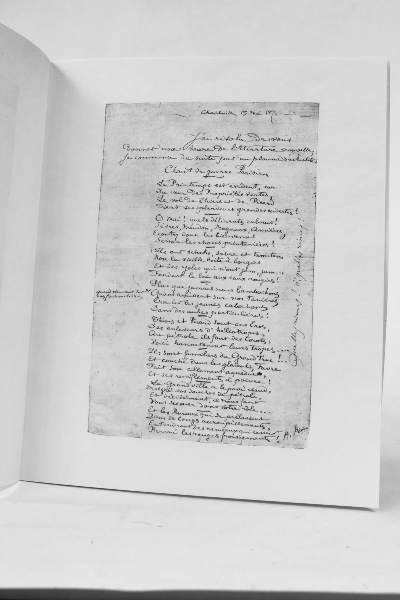
Rimbaud approached poetry with the same rebel spirit he brought to everything else. In Letters of the Seer (Lettres du voyant), at sixteen, he lays out a process aimed at breaking free from conventional thought and language to experience reality differently.
He calls it a “rational disordering of all the senses.” He meant exposing himself to extremes —love, suffering, exhaustion, intoxication, sleeplessness, psychological stress—to push perception beyond its usual limits and create new symbolic relationships between words, colors, emotions, and ideas.
His poem Mystic is a good illustration of that technique.
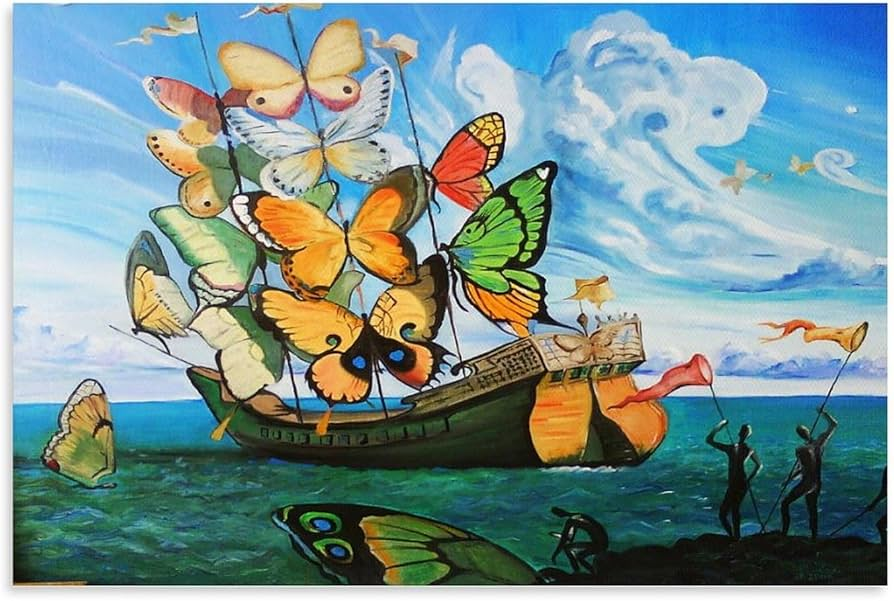
Salvador Dalí built a method around destabilized perception too. Through what he called the paranoiac-critical method, he tried to generate irrational associations —double images, meaning-shifts—while remaining lucid enough to produce work. The result is the signature Dalí effect: a single object carrying multiple realities at once; symbols morphing; the world becoming dreamlike and, well, surreal.
Culture tends to romanticize these states because they can produce extraordinary art. But they can also be exhausting to experience.
Rimbaud acknowledged the destructiveness baked into his own method, and then quit writing at 21:
"He reaches the unknown, and even if, crazed, he ends up losing the understanding of his visions, he has at least seen them!"
The line between profound insight and destabilization can be thin by the artists’ own admissions.
So where does creativity stop and madness start? And is there a way to experience deep brilliance without losing yourself in the process?
GENIUS NOT HARNESSED IS JUST MADNESS
This is where the research contradicts much of the mad genius myth.
As symptoms become severe—full mania, paranoia, delusional intensity—the detachment from reality, which is inherently disregulating and carries suffering, no longer fuels art. In those states, executive functions, critical to turning perception into coherent work, are too inhibited to create quality creative work.
The creative advantage that comes from altered perception is only present when symptoms are mild to moderate: enough to broaden perception and association, but not so much that cognitive functions drop massively or the nervous system gets overwhelmed.
In the extremes, mood disorder is just suffering: depression, paranoia, mania or delusion can be felt as disconnection, disregulation and mental and emotional suffering. It's like losing foot with the reality inside and outside of you.
Modern psychology has also started to separate creativity into two categories:
- Creativity as disposition
- Creativity as active practice
Disposition vs. Strategy (Zhao et al., 2021).
Being highly creative as a trait does correlate with higher psychological risk. But actively engaging in creative work often improves emotional regulation and wellbeing.
This means artists would be better served by seeking ways to regulate their conditions, via medication, or regulating practices.
The irony is that many artists fear treatment because they worry stability will destroy their creativity.
But many studies suggest the opposite: creative individuals often produce their best work during relatively stable states where insight and executive function can coexist.
Artists who fear treatment know that the intensity with which they feel and perceive things is linked to the creativity of the work they produce. They are likely terrified of losing the only thing that makes life feel vibrant, singular and meaningful.
But paradoxically, the refusal to find ways to regulate, whether through treatment or alternative forms of regulation, can ultimately prevent them from achieving their best work.
Amy Winehouse is a tragic example of that fear: she had immense talent, immense pain, and she repeatedly refused the very treatment that may have helped stabilize her.
Lady Gaga is an advocate in the other direction: someone who speaks openly about mental health care as part of staying alive and staying functional, without framing stability as the death of creativity and art expression.
The point is that the myth, in my opinion, gives artists a false binary: be brilliant or be well.
I relate to this fear more than I like to admit. I’ve refused medication for my neurodivergence and high anxiety my entire life. But I’ve learned to regulate myself to the point where my symptoms are now very mild.
It doesn’t mean the creative process isn’t challenging, or that suffering isn’t part of it. For me, when I’m creating, whether for this blog or for my work, I go through intense periods of thinking, researching, processing, experimenting, iterating, and frantic rumination. It can feel all-consuming, overwhelming, and isolating. I can lose my footing with the outside world, and my body. It's like nothing else matters, and all I can do or think about is that one thing I'm trying to accomplish.
But I now know how to regulate through structure (sleep, food, and exercise are unconditional) and alternative medicine. I've learned that non-stop work, lack of sleep, chain smoking and obsession won't get me there faster or better. Quite the opposite: rest and regulation improve results.
I think some level of intensity can be part of the process. Obsession isn't inherently a bad thing. But the mind, body and heart need rest and regulation to produce the best results over time. And finding sustainability and joy in the process can be healing as more and better work gets produced over time.
The challenge is not eliminating sensitivity. It is learning how to navigate it gracefully.
THE MYTH IS JUST A MYTH
I think culture became overly attached to the image of the self-destructive artist because pain undeniably deepens perception.
Whether caused by a mood disorder or circumstantial life adversity, pain cracks our hearts open.
Extreme sensitivity changes art. Heartbreak changes art. Grief changes art. Isolation changes art.
Pain often increases emotional salience and forces deeper confrontation with the self.
Personally, I always found my way back to playing music or writing in moments of pain. And engaging in that process has always helped me process that pain.
Writing or playing music as a way to process, give meaning and express has been shaping me as much as I’ve shaped emotions into form through art.
Pain and struggle are core parts of the creative process.
But pain and creativity are not the same thing. Pain may deepen emotions and perspective, but it does not automatically improve someone’s ability to shape that raw material into something meaningful and beautiful.
Those are different processes. There is a difference between feeling deeply and being able to create coherently from what you feel.
History tends to remember the brilliance of people like Van Gogh or Cobain, but overlook the reality that many of them were also profoundly overwhelmed by their own sensitivity and conditions.
The tragedy is not that creativity requires pain and suffering. Because pain is part of the process, and it’s part of life.
The tragedy is that unusually perceptive minds often struggle to find stability in a world that isn’t built for the way they experience reality.
The real challenge for creative people is not choosing between brilliance and stability or mental health.
It is learning how to remain open enough to perceive deeply without becoming consumed by their sensitivity and creative depth.
And to learn their own way of navigating their sensitivity so they can transform it into something meaningful, beautiful, and human.
References:
[1] Carson, S.H., Peterson, J.B., & Higgins, D.M. (2003) — Decreased latent inhibition is associated with increased creative achievement in high-functioning individuals, Journal of Personality and Social Psychology
[2] Mednick, S.A. (1962) — The associative basis of the creative process, Psychological Review.
[3] Benedek et al. (2012) — Associative chains and the creative process, Cognitive Psychology.
[4] Jung et al. (2013) — The structure of creative cognition in the human brain, Frontiers in Human Neuroscience.
[5] Kapur, S. (2003) — Psychosis as a state of aberrant salience, American Journal of Psychiatry.
[6] Berridge & Robinson (1998) — What is the role of dopamine in reward: hedonic impact, reward learning, or incentive salience?, Brain Research Reviews.
[7] Flaherty, A.W. (2005) — Frontotemporal and dopaminergic control of idea generation and creative drive, Journal of Comparative Neurology.
[8] Ellamil et al. (2012) — Evaluative and generative modes of thought during the creative process, NeuroImage.
Member discussion