Going All In Without Holding On

For a long time, I confused agency with control.
As a producer, my early career was built on the high of bringing structure to chaos: driving large teams of artists, engineers and designers to work together under tight deadlines to deliver on ambitious visions. I was good at it; I lived for the adrenaline of a deadline and the pride of being the "closer".
I anticipated problems before they surfaced, which meant I was always looking for what was wrong. I'd take it upon myself to fix those problems when I could, which meant I was working 70-hour weeks as a baseline. And when I couldn't fix them, I'd escalate, expecting management to correct what was surely going to derail the plan. If the course didn't change, I didn't stay. I wasn't willing to invest where I didn't trust that the structure would resolve the uncertainty.
For some time, that approach proved me right. I shipped several major games, left studios before they closed, and joined others before they peaked. But because it worked on many occasions, I learned the wrong thing. I became controlling.
The tools that made me a great producer -pushing, persevering, forecasting and driving toward a vision- were the exact things that started working against me. You can't project manage a human heart, or expect R&D to follow a plan.
The more I tried to grip the steering wheel, the more the car skidded. Progress at work turned into friction. At home, the harder I tried to build the life I'd imagined, the more it slipped away.
What I eventually learned slowly is that I had been focused on the wrong thing. We can't control the road. We can only control the hands on the wheel.
And paradoxically, shifting my focus from trying to force outcomes to choosing my response is what actually changed them, and changed me. Not always. But more than forcing things ever did.
THE FILTER
I used to think my instincts and forecasts were reliable. Now that I've learned more about how the brain works, I know that it was producing thoughts through the lens of fear, anxiety, and insecurities.
Science shows that the brain is not designed to be a truth teller; it's designed to be a pattern matcher. It pulls from old fears, old worst-case scenarios, and deep seated insecurities to constructs a story to justify how we feel in the moment.
It can even ignore visible evidence if that evidence contradicts what we already believe - all so we don't have to question our assumptions.
It’s the automatic lens that turns a partner’s silence into 'rejection' or a colleague’s critique into an 'attack.'
We don't do this on purpose. Cognitive biases, or filters, developed as evolutionary shortcuts: ways for the brain to process information fast, prioritize survival, and conserve energy.
For most of human history, that speed was the point. But the same mechanism that helped our ancestors survive predators doesn't serve us well in modern life, with its complex, ambiguous decisions and relationships.
Good decisions require an accurate picture of reality, and we can't get that from a system running on antiquated fear. So what's the alternative?
GAINING CLARITY
Radical acceptance, or surrender, requires discernment instead. Discernment is slower. It doesn’t care about the fact that we want to be right; it’s simply curious about the actual truth.
For a long time, I thought surrender meant giving up. But it’s not. It’s an intentional decision to withhold our own interpretation of what's happening. It's the choice to stop the "story" the brain is writing so we can see what is actually going on with clarity.
Looking back, I can see how often I resisted that:
- At work, I minimized evidence that a project was drifting because my "pattern matcher" told me that changing direction mid-development meant failing. I stayed the course because it felt safer than the uncertainty of a pivot.
- In my relationship, my partner and I had started with the same vision. But at some point, our readiness for that life had diverged in ways neither of us could fix. And instead of facing this fundamental misalignment, we fought about timelines. Because that was something we could try to "manage", but not the reality underneath.
Acceptance would have required me to confront things I didn't want to accept. That is the cost of clarity.
Saying no to a partnership I was so certain would be forever was brutal. For a while, everything I feared came true: I was 39, and without the family I’d planned. But admitting that truth also restored my peace. It’s not the life I imagined, but it’s a life I can choose. And it can still be beautiful.
Seeing clearly is deceptively hard. It requires pausing long enough to process emotions and thoughts, before formulating a more accurate perspective. This is a skill that takes a lifetime.
SITTING WITH IT
To see clearly, we need to interrupt the automatic loop between perception and reaction. Most of the time, it happens so quickly, we don’t even realize.
The Stoics called this process Synkatathesis: the discipline of withholding immediate judgment. In modern terms, it’s the ability to regulate our internal state before forming a conclusion.
In practice it’s very concrete, but it goes against every instinct.
It requires stillness exactly when everything in you wants to react and relieve the tension inside.
When you want to flip the driver who cut in front of you. Or fix every single problem you see at work because you feel as if things will fall apart if you don't. It’s the discipline of not trying to solve a problem while your heart rate is still at 110 bpm.
Now, when I feel frustration, anxiety or fear, I notice my emotional reaction first, and I pause. I've learned not to trust the stories my mind creates when I'm inside the emotions, nor to suppress the emotion. I store those stories as "to be revisited when I'm no longer spiky" folder, and regulate my nervous system before I do so. I breathe deeply, take a walk when I can, and let the emotions settle.
Here's why it's never a good idea to think through problems when we're in the middle of tense emotions, or triggered:
When the nervous system is activated, everything narrows down. Decisions become reactive, and we respond quickly to resolve the tension. When it settles, our field of view expands. We don’t just gain perspective; we regain the ability to be creative and find solutions we would never think about when activated.
That said, you can't always walk away from a tense moment, especially when you're leading a room. That's why it's important to flex the muscle of steadiness outside of those moments.
I think of it as building a higher floor: the more consistently I invest in practices that regulate my nervous system — for me it's exercise above everything else — the more steadiness I can pull from when things get hard. It's a new baseline; it means it takes a whole lot more to knock me off my feet.
When that baseline is solid, it gets easier to slow down and stay grounded even in challenging moments. It's almost like bullet time in the Matrix: you notice the emotion coming, you feel it, and instead of reacting to it, you let it sit with you, and stop the mind from wandering into negative places. You stay present, stay focused, and choose what to think and do.
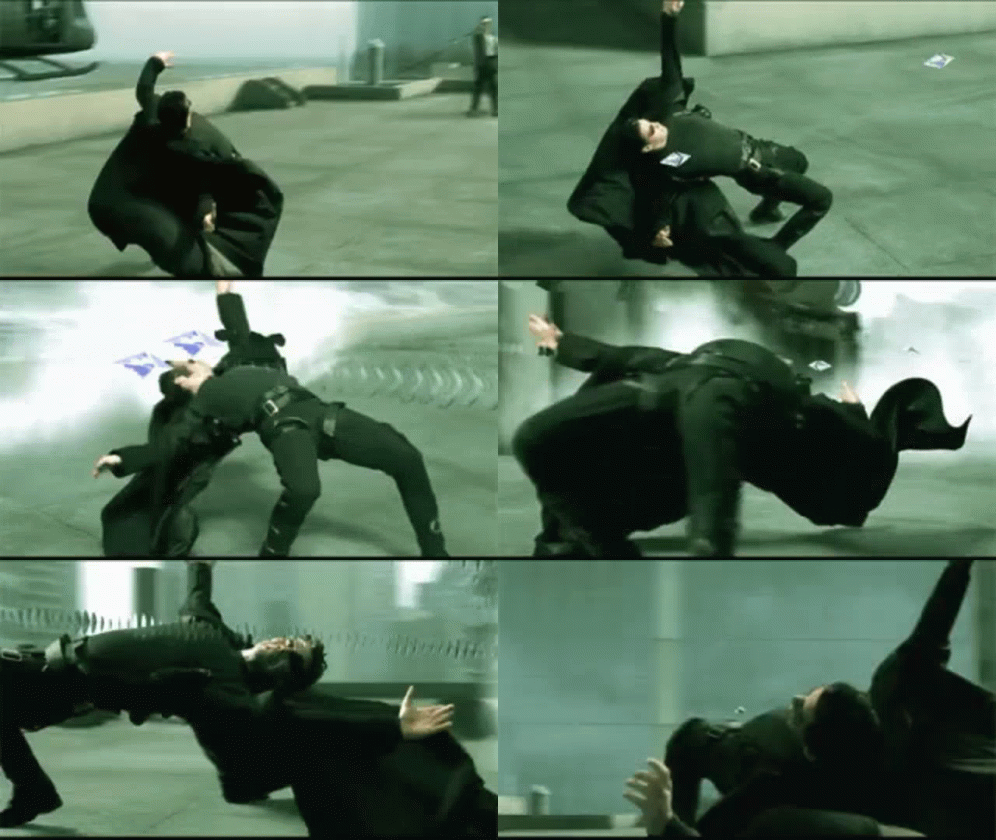
But not all situations can be processed in the moment, or even in the matter of days, weeks, or even months. Some, like loss, grief, require a lot more time, and a different kind of effort.
The work is to sit with the experience long enough to see layers and layers of new meaning. It can take months. It can take years. And that's okay. The stillness required is uncomfortable, which is why we often try to skip it - replacing loss with distractions, validation, or new attachment. But avoiding the discomfort only postpones the lessons. We end up moving, but not moving forward.
In retrospect, I don't regret leaving the relationship. But I regret doing it from the narrow field of view of resentment rather than the wide lens of compassion that only the pause makes possible. That is what happens when we skip the pause.
Today, I want to trust that even in the most difficult moments, I can pause and choose my response. Because that space is what makes intentional action possible.
HANDS ON THE WHEEL
That’s the shift.
Not controlling what happens, but taking responsibility for how we respond to it. This is what psychologists call the locus of control: the difference between what we can direct and what we can only influence.
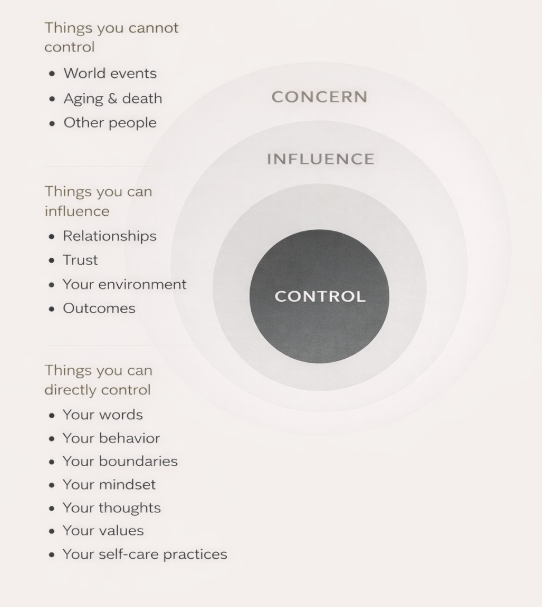
So the work changes. It's less about forcing a specific outcome, and more about engaging with reality, as unpleasant as it is, with intentionality.
It's about making clear, values-aligned decisions based on what the situation demands, and not just what we'd prefer.
Something I've gotten used to, for instance, is supporting employees who announce they're leaving. When the 'Can we chat?' ping hits my Slack, my stomach still drops. My old instinct is still to list all the reasons they should stay and see how I can retain them. But now, I take a deep breath and listen. I still explore whether there's a path for them to stay. But if what they need isn't something I can offer, or something that makes sense to change, I accept it. I choose to support their transition even after they've left. And I actually mean it when I say, 'I'm happy for you.'"
Every major setback I've encountered eventually revealed itself to be a blessing in disguise. Changes in direction led to better results. Difficult separations created space for new people that fit better. The losses were real, but so was the value that came after.
It taught me not only to change how I navigate setbacks, but also how I view them.
FROM CONTROL TO POWER
When we start seeing setbacks not as something to avoid, but as something to learn and grow from, we start to move from a place of fear and control to a place of power and trust.
Trust in what will come next, and trust in our ability to handle it.
My ambitions are still the same: building a family, creating games that resonate with millions, living a meaningful life. I haven't "surrendered" these dreams and ambitions, and some days the ache is very real.
But I know I won't be broken by it if it doesn't happen exactly as planned - or at all. Quite the opposite: I trust I'll figure it out, and come out stronger, softer, and more confident, on the other side.
I've come to believe that adversity isn't the obstacle to creating something extraordinary; it's the condition for it.
Now, when problems arise, or when I experience failure, I no longer view those setbacks as the enemy, something to quickly fix, avoid, or put behind. I remember that they're a part of the journey, just like the wins and the good moments. And I choose to see them as powerful catalyst for change and growth. That is the mindset I bring to my teams as well. When something goes wrong on our project, I immediately default to: "this is good, it means we missed something and we can get better if we learn from it. Let's focus on that." It immediately shifts the tone, and the mind space.
And the harder the circumstance, the greater the opportunity.
Being single at 39 is also allowing me to invest in myself like I never have before. I get to write about what I'm interested in, invest in my health and fitness, new friendships and projects, and consider how badly I want children in my life. And in doing so, I'm becoming someone more grounded, peaceful, confident, and more aligned.
My dreams now define why I do what I do, and where I invest my time, but they no longer define my identity.
Whether a day goes well or not, what I do stays the same: I show up and do the work, fully engaged with what's in front of me, right now.
I still go all in on a vision, not because I'm certain it will work, but because the pursuit itself is worth it.
And if it doesn’t work, or needs to change, I adapt. I don't lose myself in the outcome. I choose how I meet the moment.
From that place, joy and confidence replace fear—not as a reward for winning, but as a consequence of showing up fully.
With clarity.
With courage.
With integrity.
In the end, this is the only part that is ever truly ours.
GOING FURTHER
If you want to explore some of the ideas in this piece more deeply, these were particularly helpful to me:
Stillness is the Key — Ryan Holiday
A practical take on cultivating stillness in the middle of action. This connects directly to the “pause” and the space between perception and response. Video summary from the author here.
The Obstacle is the Way — Ryan Holiday
A perspective shift on adversity: instead of resisting obstacles, learning to work with them. This shaped how I think about uncertainty and setbacks. Video summary from the author here.
Sài Wēng Shī Mǎ proverb (The old man lost his horse)
A Taoist parable that illustrates how difficult it is to label events as “good” or “bad” in the moment. A useful reference for discernment over judgment.
Taoism & Buddhism on detachment (long-form video)
A deeper philosophical exploration of non-attachment and acceptance. Less tactical, but helpful in understanding the underlying principles behind surrender.
Member discussion