Change Sucks But You Don't Have To
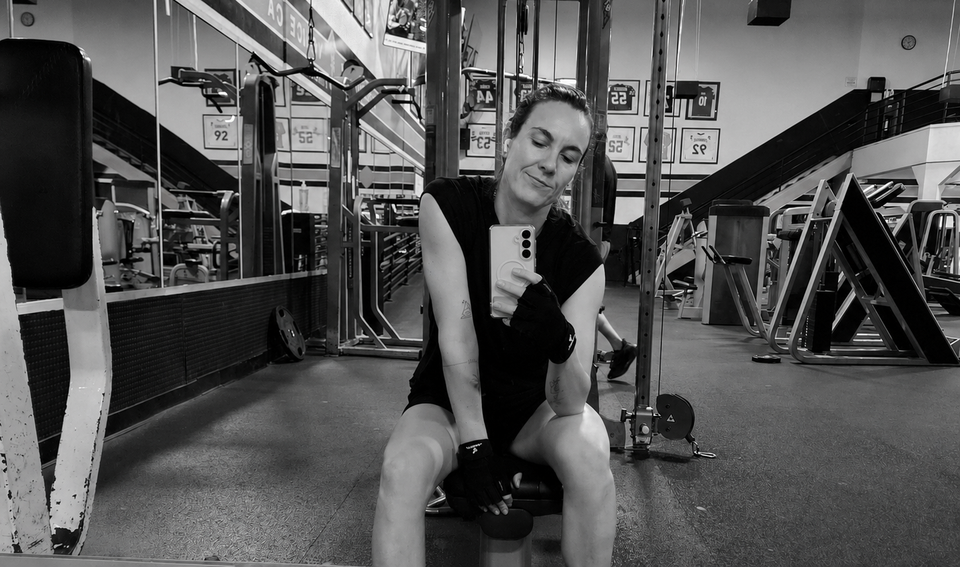
I'm not good enough. I'm too young to be CEO. I don't deserve success. I'm too old to learn how to skateboard. I don't have time to go to the gym. And I definitely love eating too much to ever have a six pack.
We all have limiting beliefs, and we often don't even realize we have them.
Modern psychology and spirituality inundate us with literature telling us we can be whatever and whoever we want to be. In some ways I believe that's true.
But it also sells a lot of shortcuts, to help skip over the thing that is core to any change: the suck.
There are many things that suck about change, and however you want to spin it, the entire point is to learn to embrace it.
Undermining the degree of suck doesn't do anyone a service.
Quite the opposite: it risks making us think we're doing something wrong when we're not succeeding.
When truly, failure and frequent feelings of inadequacy, doubt and fear are inherent to any change.
If you're not failing, you're not doing anything new.
But why do some people seem to navigate it more elegantly and effortlessly than others?
THE SUCK
My skateboard coach broke learning down into four phases, and I've found it applies to just about any skill, from having hard conversations in a way that builds trust, to landing a 360 out of the Venice bowl.
You've probably heard about this framework, it's not new or niche:
- Unconscious incompetence. You don't know what you don't know. You can't even see the gap yet.
- Conscious incompetence. Now you see it. You know exactly what you're bad at, you know why, and you know what you'd have to do about it.
- Conscious competence. You're getting good at the thing, but you still have to pay attention and exert a lot of effort to be good at it.
- Unconscious competence. You're good at it and you don't have to think about it. Congratulations. That's mastery.
Everyone wants to go from one to four fast.
Me first.
I'm not patient.
Why can't I get there yesterday?
Lame.
Here's what I finally understood once I became an Executive Producer and had to lead change in large organizations — and once I decided that, after all, why couldn't I have a six pack?
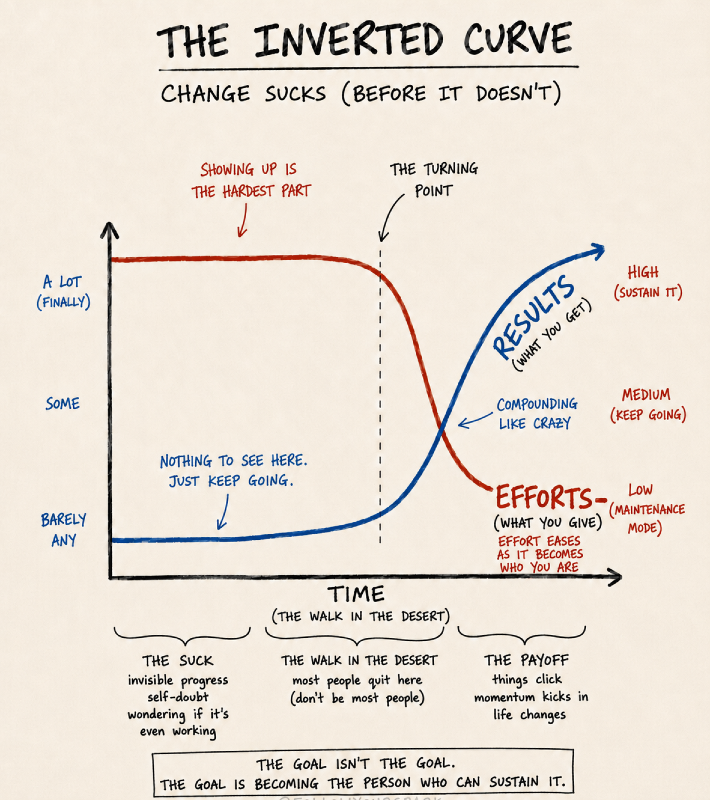
Stage two to stage three is the long walk in the desert. It lasts way longer than you'd expect or than what anyone will tell you.
It also requires the greatest amount of effort.
That's why it sucks!
And that's where many people give up or stay stuck.
I have two things to say about that walk in the desert:
- One: the suck is an integral part of the process. If you're not feeling it, you’re probably not doing anything that requires you to change.
- Two: it takes an extraordinary amount of sustained effort for minimal payoff, for a long time, before the curve (effort to results) starts to invert.
Just kidding, there are three things. Finally some good news: the more times you run the loop from one to four on any new skill, the more you learn to enjoy the suck.
It stops making you feel bad about yourself. It becomes expected. And kinda fun.
THE SUCK IS NECESSARY
The first thing is about mindset. If you don't understand this, you won't recognize the test when it shows up.
Change is, in essence, a test of our ability to stay in discomfort. That's it. Once you understand that, it changes everything.
I’ve seen this pattern with nearly every person making the jump to Director in the work context: moving from doing the work to directing others doing the work triggers a full-blown existential crisis. Suddenly, every muscle memory that made you successful stops working. You have to stop doing and start coaching, teaching, and pointing - in the right direction.
It’s a completely different skill set, and you don't start out good at it. So not only do you have to stop doing the work you’re amazing at, you have to replace it with work you’re still awkward at. And when you stumble —which you will— the fallout isn't private. It's visible, and it impacts your team. What sucks more than failing? Failing in public, knowing it’s making everyone else’s job harder.
That really sucks.
Change forces you to unlearn what got you here to make room for what gets you there. But as humans, we hate that. We cling to what’s familiar because we know it works...or at least, it worked in the past.
Uncertainty and discomfort? Eek.
Worse yet, you don't even get immediate feedback. How do you know if you're sucking in the right way or the wrong way? Is it supposed to feel like this? Is it normal to be this anxious? Or does it mean you're screwing the whole thing up?
Am I really supposed to sit back and watch my report take a full week to finish something I could do in three hours, only for the final output to be mediocre? Should I have stepped in? Did I direct wrong? Did I delegate too fast?
That’s the hardest part: it’s impossible to know if the reps are working until you've put in enough of them to actually move the needle.
Like, at all.
And that shit takes time.
IT TAKES TIME FOR THE SUCK TO PAY OFF
Let's say you want to get better at having hard conversations. That's a thing I needed to get really good at.
When I was junior, I just avoided them. I complained to peers. That's called venting, not doing the hard thing.
Now I don't think twice before I have the conversation, and I barely prepare. I trust I can bring it up in a way that's formal but cordial, and talk it through so it feels kind, firm, and open.
But in between those two states? Years.
Years of sweating conversations. Wondering whether I should have them (if you're wondering: yes, you should). Over-preparing. Writing a script, scrapping it, writing it again. Running it by management or HR to make sure it was culturally and policy aligned. Having the conversation, feeling nervous the entire time. Sweating it afterward too.
None of that was wrong, even though it felt like it. Because surely it shouldn't be that hard, should it?
Yes. It should.
Going from not knowing how to do a thing to doing it well takes practice, iteration, trial and error, doubt, and reflection.
It takes looking back at how it went and seeing what worked, what didn't, and doing it again. Again and again.
These are the incremental moments that don't feel like payoffs but are the whole progress process.
You feel confident enough to have the conversation without asking anyone to review your script. You're more relaxed during it. Small things. Worth paying attention to, because they're telling you that you're making progress.
Worth celebrating, even when they don't feel like a big deal. It keeps you going.
And then there are big, awesome payoff moments: breakthroughs.
You don't need a script at all. You don't even prepare much, because you trust you'll weave your point into the conversation and make it a discussion rather than a one-way "I've got something to tell you" moment.
Progress isn't linear. It happens in steps. The little incremental loops eventually add up to something that actually feels like a payoff.
But it takes longer than people expect, or want.
And I've come to think it's good that it takes that long. Because of what it does to you along the way.
THE GOAL IS NEVER REALLY THE GOAL
I don't have a six pack yet. But I'm on my way.
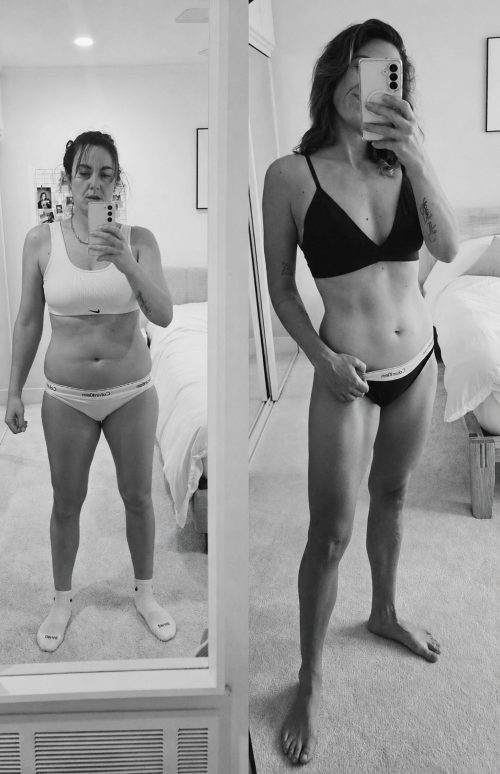
Getting from where I started to here took almost a year of consistent effort. And for a good six months, I didn't see much difference. I lost weight, I got more defined, but it took a long time for my body to actually change shape.
Fitness influencers sell three-month and six-month transformations.
I think a lot of that's bullshit.
Not because it can’t be done, but because to achieve that speed, you need to use methods that are hardly sustainable from my perspective.
The key isn't speed of progress. It's consistency, and whether you can maintain it.
Which means letting the thing reorient your life slowly enough that it can actually integrate.
Experiencing the suck and not letting it stop you. Continuing anyway, without making your entire life about that one change.
It just becomes one part of your life.
Unless you're an extreme obsessive who wants to do only that one thing. That's fine, you can do that. I just don't think most of us can live that way.
What I figured out after setting that somewhat arbitrary goal is that chasing a six pack was never going to be just about discipline in the gym.
It was going to require me to reorient my entire life's discipline and daily habits. How much I went out. How much I slept. What I ate and when. How much I walked every day. How I organized my time so I could sustain that level of investment.
What I actually signed up for was rebuilding the entire structure of my days.
Changing my body changed my life, both in the suck and on the other side.
I love how I look now. But that's not what I got. What I got was discipline, consistency, and a completely different relationship to my time and my body.
I spent my teenage years playing video games and being sedentary. Certified former fat kid and nerd. This was not on my bingo card.
That's the part that's hard to imagine when we're in step one, or two.
You think you’re signing up to get the thing.
But what you’re really signing up for is becoming the person who can actually do it, and sustain it.
AND THEN IT GETS FUN
It being hard is kind of the point.
Because effort changes the meaning of the result. You know what it took. You can remember the version of you who couldn't do it yet. That's why you're proud of it.
And after you’ve gone through the loop enough times, something changes.
You stop taking incompetence so personally.
You stop treating discomfort like a sign that you’re failing.
You recognize the loop: the awkward beginning, the long walk in the desert where nothing seems to change, the tiny signs of progress, and then eventually, the breakthroughs.
Knowing the process makes the suck easier to navigate. You just know you need to trust the process and put in the reps.
Sometimes, it even makes it fun.
Now I laugh when I get tumbled by a wave while surfing.
I smile when I see a new challenge at work I have no idea how to solve.
I know it won't be easy, but I also know I've been here before.
So instead of thinking, that shit is going to suck, I think:
Let’s see who I become on the other side of it.
Member discussion